Cognitive orgies
On the first day of brainstorming and presentation, I struggled to connect my conceptual framework with physical prototyping ideas. By the end, I realised that prototyping is a key part of the ideating process itself, and you come back to the other simultaneously in a loop. This weeks’ Cognitive Orgies session taught me to trust my gut, rework the core message and simply carry on with the process.
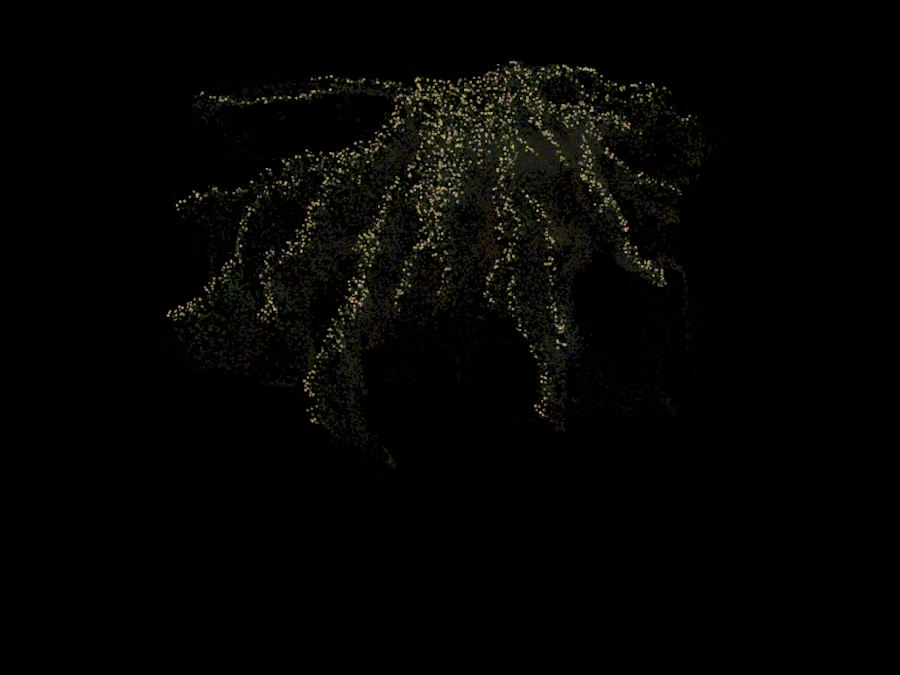
We set out to do the impossible: map the roots of a tree underground.
Echoes of Earth - Documentation
After discussing and researching root diagrams, satellite imagery and other datasets we realised our limitations. We couldn’t build a DIY tech system to do this; instead we would manipulate our way through it.
Creating fiction through technology has always been one of the premises that tech utopianists stand under. It is also something against open source culture and DIY movements. It was an ethical dilemma to fuzz up data from some other sensor and show that we were sensing roots in some way, but it was also an act of honesty to acknowledge our limitation and state that we were reading soil moisture data and using it to create a visual of roots.
By the end, we created a poetic experience that combined tech and storytelling and gave a moment of awe to the audience.
Lights, Camera, Action ..
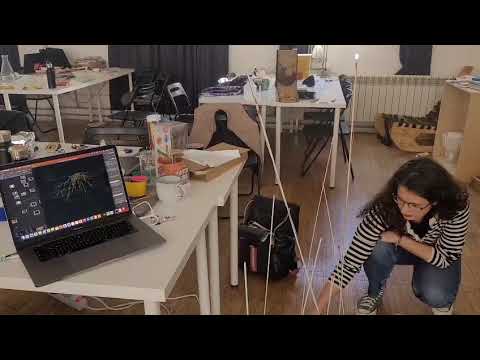
As soon as we started prototyping we divided the tasks amongst ourselves based on our strengths. Beste, our ace visual designer would work with TouchDesigner, Heba our product builder would design and sketch the physical artefact while I would act as a bridge between the two; activating sensors through the code. During the two days, amidst plenty of shared coffee breaks and lunches, I learnt how working in a team can amplify each other’s strengths and tone down our weakness, that there is always someone to catch when we felt like we were falling. The people who caught us were the entire Fablab team: Mikel, Andres, Santi, Julia and Damian.
Pushing my way through it
The second and third days were especially challenging with the coding. Plugging in one sensor and getting readings was simple; the challenge arose when multiple parts had to work together according to a logic that we had set up.
Human*AICOLLAB?
As a writer myself, I have a disdain for using AI to help write or generate any type of design ideas. Coding is the only thing that I use AI for. However, I would’ve not been able to code with this much fidelity, had I not solicited help from other documentations and the mentors from Fablab. A combination of reading code from other websites and human help along with ChatGPT made it a great learning experience. I enjoyed learning the logic of how a simple program operated and how I could build on it to make a more complex one. Just making two microcontrollers communicate to each other using a simple protocol was magical enough. Adding lights, sound and other elements to the whole setup made the process even more rewarding.
Challenges and Room for improvement
From the first discussion itself, we wanted the prototype to follow a simple logic. We didn’t want to complicate it with too many sensors or logic. We wanted the translation of input to output to be clear and readable by the audience yet be aesthetic in its expression.
However we still faced some challenges when adding on lights and then continuing to read the sensor data and make them loop. I was very scared of using the lights without a resistor, wondering when one might go off and explode.
Currently our sensor is very rooted to the ground and would make for a nice art installtion. The problem with soil moisture data is that it doesn’t rapidly change over time, so you wouldn’t be able to see the changes reflected in the lights immediately. Adding in some sort of movement to the sensor or other sensor that would affect the data though human interaction might make the project more conversational and interactive than it is right now.